API Holdings (PharmEasy) Unlisted Shares: Reverse Merger Depends on Debt-Free and Profitable Operations
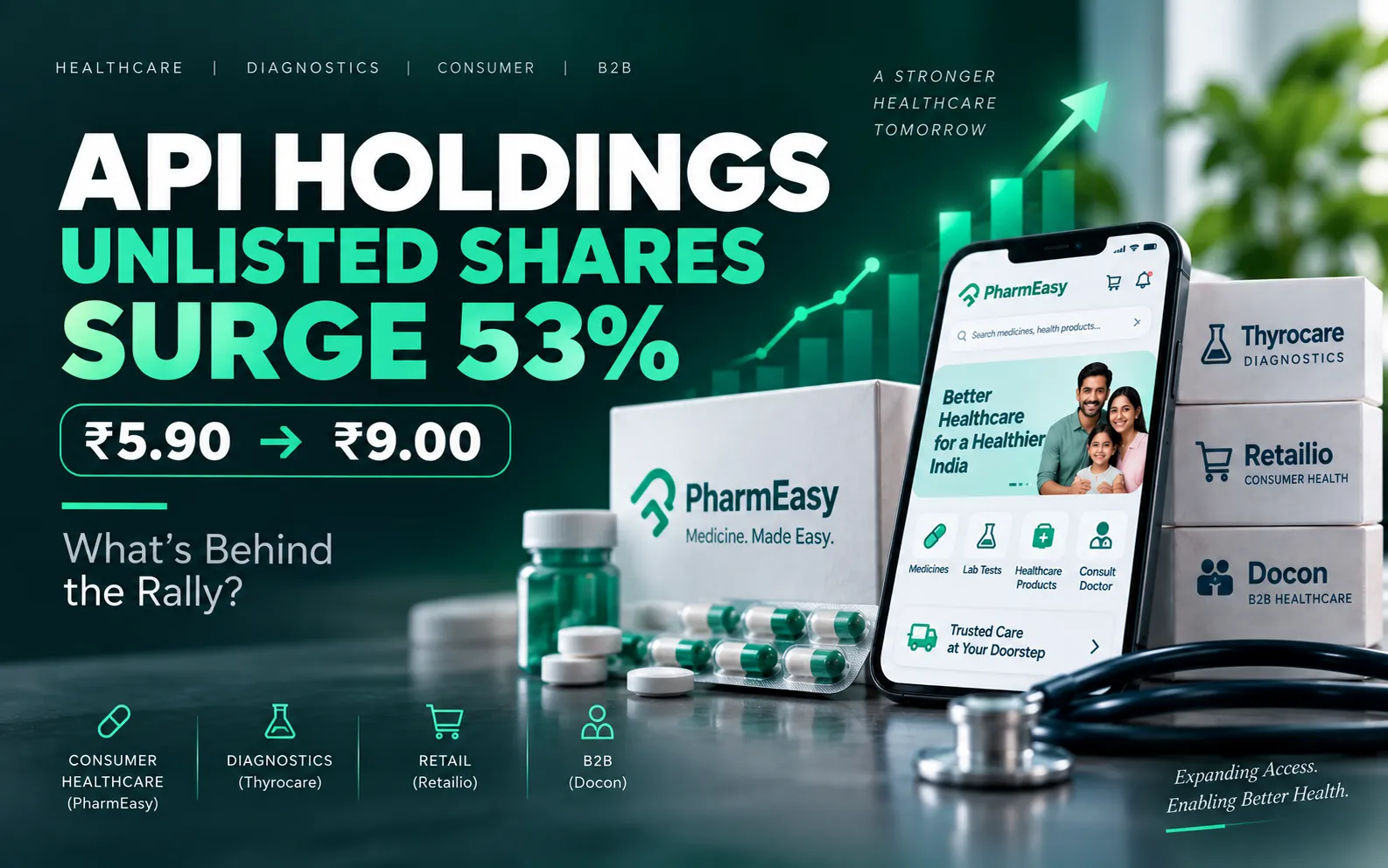
API Holdings (PharmEasy) unlisted shares are back in focus after Rahul Guha, MD & CEO of API Holdings and Thyrocare Technologies, clarified the company's position on a possible PharmEasy reverse merger.
According to comments reported by CNBC-TV18 on August 13, 2026, an immediate reverse merger of online pharmacy platform PharmEasy into listed diagnostics company Thyrocare is not on the cards. Guha said that two key conditions must first be met: API Holdings needs to become debt-free and profitable at the pre-tax level, excluding Thyrocare.
The latest development is significant for investors tracking PharmEasy unlisted shares, particularly because the company has previously been associated with plans for a public-market listing.
PharmEasy Reverse Merger Not Imminent
Rahul Guha ruled out an immediate reverse merger of PharmEasy with Thyrocare Technologies.
Instead, the company will first focus on strengthening API Holdings' balance sheet and achieving profitability. Guha said that only after these milestones are achieved will the group evaluate different options, including an independent listing of PharmEasy or a reverse merger.
The comments came shortly after a major block deal in Thyrocare shares on August 12, 2026, when approximately 1.3 crore shares worth around ₹822 crore changed hands.
Guha confirmed that API Holdings sold a 10% stake in Thyrocare, with the primary objective of using the proceeds to make the group debt-free.
API Holdings currently carries around ₹1,050 crore of debt. Guha said the company expects to become debt-free within days once the proceeds from the stake sale are received.
Importantly, he also confirmed that the promoter does not intend to reduce its ownership in Thyrocare below 51%.
Two Conditions Before Any PharmEasy Reverse Merger
The management has outlined two clear conditions before the group considers a reverse merger or another public-market route for PharmEasy.
API Holdings must become debt-free
The first condition is reducing API Holdings' outstanding debt.
The company currently carries approximately ₹1,050 crore of debt, and the recent Thyrocare stake sale is intended to address this liability.
Guha expects the group to become debt-free within days after receiving the proceeds from the transaction.
API Holdings must become profitable
The second condition is profitability.
The management wants API Holdings to turn profitable at the pre-tax level, excluding Thyrocare.
Guha expects this milestone to be achieved by the end of FY2026-27 (FY27).
Only after both the debt-free and profitability milestones are achieved will API Holdings assess the next step for PharmEasy.
The company is therefore considering two possible routes in the future:
- An independent listing of PharmEasy
- A reverse merger involving PharmEasy and Thyrocare
Guha also estimated that PharmEasy could potentially become profitable within the next three to four quarters.
Why the Thyrocare Stake Sale Matters for API Holdings
The Thyrocare transaction is important because Thyrocare is a major part of the API Holdings healthcare ecosystem.
API Holdings operates an integrated healthcare platform spanning online pharmacy, diagnostics, healthcare supply-chain services and technology-enabled healthcare offerings. The company's business ecosystem connects consumers and multiple healthcare stakeholders including pharmaceutical companies, pharmacies, hospitals, doctors, clinics and diagnostic laboratories.
Thyrocare remains a key growth driver for the group.
Guha stated that API Holdings' decision to sell part of its Thyrocare holding is primarily aimed at reducing debt rather than giving up control of the diagnostics business.
The promoter's commitment to maintaining at least a 51% stake in Thyrocare is therefore an important aspect of the latest development.
Thyrocare Continues to Drive Growth
While the PharmEasy business works toward profitability, Thyrocare continues to be the group's major growth engine.
According to Guha, Thyrocare has delivered more than 20% year-on-year growth for eight consecutive quarters.
The diagnostics company reported 26% growth in the April-June 2026 quarter, ahead of Guha's previous guidance of high-teens to 20% growth.
He said the company would reassess its growth guidance after reviewing the second-quarter numbers.
Thyrocare also reported a market capitalisation of approximately ₹9,758.43 crore, with its shares having gained more than 35% over the last year, according to the report.
What About the Proposed Drug Pricing Rules?
Another issue discussed by Guha was the government's proposal to limit the difference between the landing cost and maximum retail price (MRP) of drugs and medical devices to 20%.
Such a proposal could have implications for API Holdings' pharmacy distribution and online pharmacy operations through PharmEasy.
Guha said PharmEasy already provides customers with significant discounts to MRP and believes the business falls within the proposed limit in its role as a distributor.
However, he did not comment on the manufacturing side of the proposal because API Holdings does not manufacture drugs.
Thyrocare Targets Expansion in Speciality and Genomic Testing
Guha also highlighted an opportunity in speciality and genomic testing.
At present, this segment accounts for almost none of Thyrocare's revenue, compared with around 15-20% for some peer companies.
Management expects Thyrocare to reduce this gap over the next three to five years.
Despite this expansion, Guha does not expect the company's long-term margin guidance to change materially.
Thyrocare continues to target a 32-33% steady-state margin, although Guha acknowledged that there could be some short-term impact as the speciality and genomic testing business scales.
He also indicated that the company would prioritise growth over returning to the 35-40% margins Thyrocare reported historically.
What Does This Mean for API Holdings (PharmEasy) Unlisted Shares?
The latest comments provide greater clarity around the possible future of API Holdings (PharmEasy) unlisted shares.
The immediate focus is not a reverse merger or listing announcement. Instead, management has identified two financial milestones that need to be achieved first:
Debt-free status + pre-tax profitability excluding Thyrocare.
The recent Thyrocare stake sale is intended to help address the first milestone, while the second depends on the continued improvement in API Holdings' underlying business performance.
This means the future public-market route for PharmEasy remains dependent on business and financial performance rather than being an immediate corporate action.
Investors tracking PharmEasy unlisted shares should therefore distinguish between a potential future listing or reverse merger and the company's current priorities of debt reduction and profitability.
API Holdings and PharmEasy: What Investors Should Watch
For investors following PharmEasy unlisted shares, the latest development makes several indicators particularly important.
Debt reduction: API Holdings' ability to use the Thyrocare stake-sale proceeds to become debt-free is a key near-term development.
Profitability: Management expects API Holdings, excluding Thyrocare, to reach pre-tax profitability by FY27. This is an important milestone for any future public-market strategy.
PharmEasy business performance: Guha expects PharmEasy could become profitable within the next three to four quarters.
Thyrocare performance: Thyrocare remains the group's growth engine, with strong recent growth and a stated intention to retain at least 51% promoter ownership.
Potential listing route: Once the required financial milestones are achieved, API Holdings could evaluate an independent PharmEasy listing or a reverse merger with Thyrocare.
API Holdings (PharmEasy) Unlisted Shares: Outlook
The latest management commentary does not indicate an immediate PharmEasy IPO or reverse merger.
Instead, it establishes a more clearly defined sequence: reduce debt, achieve profitability, and then evaluate the appropriate route for PharmEasy.
For the API Holdings unlisted shares story, this shifts attention toward the company's underlying financial progress rather than near-term speculation around a listing.
For investors monitoring PharmEasy unlisted shares, the next major milestones to watch are therefore the group's debt position, API Holdings' standalone profitability and management's eventual decision on whether PharmEasy should pursue an independent listing or a reverse-merger route.