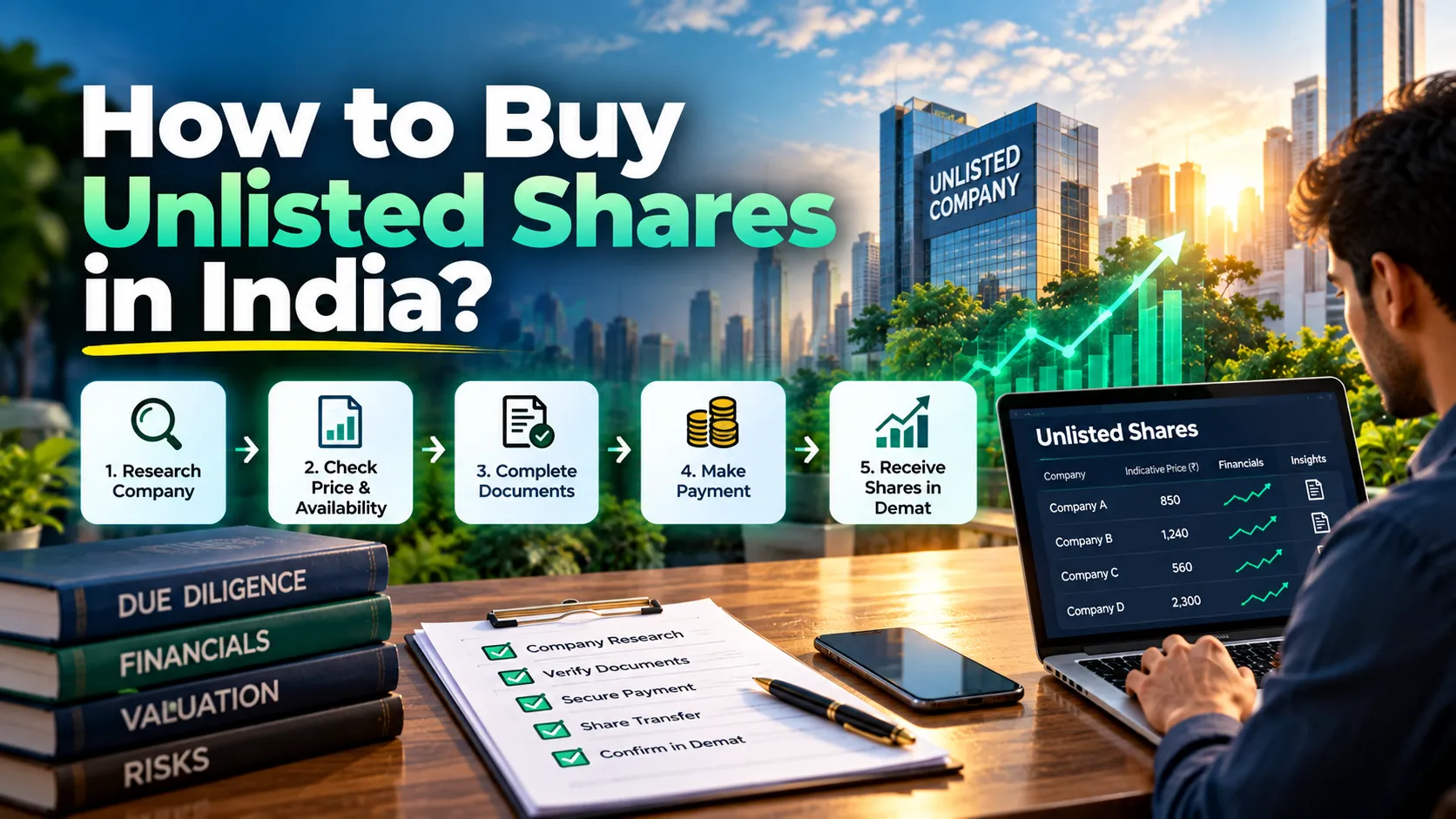
Selling unlisted shares in India requires a different process from selling shares listed on the NSE or BSE. Since unlisted shares are not traded through the regular exchange order book, investors generally need to identify a suitable buyer, agree on a price, complete the required transfer formalities and ensure that payment and share delivery are handled securely.
Whether you hold pre-IPO shares, shares of an unlisted company or shares that were delisted from a recognised stock exchange, understanding the selling process can help you make an informed decision.
In this guide, we explain how to sell unlisted shares in India, how to find buyers, how prices are determined, which documents may be required, how shares are transferred through a demat account, and what sellers should check before completing a transaction.
Can You Sell Unlisted Shares in India?
Yes, unlisted shares can generally be sold to an eligible buyer, subject to the applicable legal requirements, the company's governing documents and any restrictions that apply to the specific shares.
However, selling unlisted shares is not always as straightforward as selling listed shares through a stockbroker. There may not be a readily available buyer at your preferred price, and the transaction may require direct coordination between the buyer, seller and the relevant intermediaries.
Before proceeding, check the following:
- Whether your shares are held in a demat account or in physical form.
- Whether the shares are freely transferable or subject to restrictions.
- Whether the company has an active market among potential buyers.
- Whether you have verified the quantity, ISIN and ownership details.
- Whether the proposed price and payment terms are acceptable to you.
The ability to sell shares depends on the specific company, the availability of buyers and the applicable transfer requirements. A quoted or indicative market price does not guarantee that a buyer will be available at that price.
How to Sell Unlisted Shares in India: Step-by-Step Process
The process can vary depending on the company, the buyer and the transaction arrangement. The following steps provide a practical overview for an investor holding unlisted shares in a demat account.
Step 1: Identify the Shares You Want to Sell
Start by confirming the exact company and quantity of shares you hold.
Review your demat account statement or holding statement and verify:
- Company name
- ISIN, where applicable
- Number of shares available for transfer
- Whether the shares are pledged, frozen or otherwise restricted
- Acquisition details and purchase records
If you hold shares of multiple companies, evaluate each holding separately. Demand, liquidity and buyer availability can differ considerably from one company to another.
Step 2: Check the Latest Indicative Price
Before approaching buyers, check the latest available indicative price for the company.
You can begin by reviewing the company's page on Unlisted Arena, where available, to examine its indicative share price, financial information, valuation metrics and other relevant details.
Visit the Unlisted Shares List to explore company-specific information.
Remember that an indicative price is not necessarily an executable selling price. The actual price you can obtain may depend on demand, the quantity offered, the buyer's valuation, available liquidity and the terms of the transaction.
Step 3: Find a Potential Buyer
Once you have assessed the price, the next step is to identify a buyer interested in purchasing your shares.
Potential routes may include:
- An interested individual or existing shareholder.
- A dealer or intermediary that facilitates transactions in unlisted shares.
- Another eligible counterparty willing to purchase the shares, subject to applicable requirements.
Not every buyer will be interested in every company. Some shares have an active secondary market, while others may have limited demand or take longer to sell.
When dealing with an intermediary, clarify whether it is purchasing the shares for its own account, introducing a buyer or facilitating a transaction between counterparties. These arrangements can involve different payment terms and risks.
Step 4: Agree on the Selling Price and Transaction Terms
After identifying a potential buyer, confirm the price per share and the total consideration.
For example, suppose you hold 500 unlisted shares and agree to sell them at ₹250 per share.
| Particulars | Amount |
|---|---|
| Number of shares | 500 |
| Agreed price per share | ₹250 |
| Gross sale consideration | ₹1,25,000 |
The example is illustrative and does not represent a current market quote.
Before proceeding, confirm the following in writing:
- Company and ISIN of the shares being sold.
- Number of shares to be transferred.
- Agreed price per share and gross consideration.
- Any brokerage, facilitation charges or other transaction costs.
- Payment method and payment timeline.
- Share-transfer procedure and expected completion timeline.
- What happens if the transfer cannot be completed.
Do not rely solely on a verbal price indication. The final transaction should be based on clearly agreed terms.
Step 5: Verify the Buyer and Payment Arrangement
Before transferring shares, verify the counterparty and understand how the payment will be made.
For a direct transaction, confirm the buyer's identity and the details required to complete the transaction. When using an intermediary, understand its role and the safeguards available under the proposed arrangement.
Pay particular attention to the sequence of payment and share transfer. If payment and delivery are not handled simultaneously, establish clear written terms and assess the counterparty risk before proceeding.
Avoid transferring shares based solely on screenshots, informal messages or unverified payment confirmations. Verify funds through your bank account and follow the agreed transaction process.
Step 6: Complete the Required Demat Transfer Formalities
Most dematerialised unlisted shares are transferred through the relevant depository and depository participant (DP) processes.
Depending on the depository, account setup and transfer method, you may need to submit a transfer instruction through the applicable online facility or your DP. The required details and authorisation process can vary.
Typically, the process involves confirming the recipient's demat details, entering the correct security and quantity, selecting the applicable transfer option, and authorising the instruction.
CDSL describes a transfer between beneficial-owner accounts within its system as an off-market transaction. Transfers involving accounts in different depositories may require an inter-depository transfer process.
Important: Verify the recipient's demat details, the security and the quantity before authorising any transfer. A demat transfer instruction should only be submitted after you have understood and agreed to the transaction terms.
Step 7: Confirm Receipt of Payment and Completion
Once the transaction has been processed, check that the payment has been received in accordance with the agreed terms and that the share transfer has been completed.
Keep copies of:
- The agreed transaction terms or contract note, where applicable.
- Bank payment and receipt records.
- Demat transfer instructions and acknowledgements.
- Relevant demat statements.
- Purchase records and other documents needed to calculate capital gains.
Retaining these records can help resolve discrepancies and support your tax reporting.
Where Can You Sell Unlisted Shares?
There is no single route that works for every company or seller. The most appropriate route depends on the shares you hold, their market demand and the transaction terms you are comfortable with.
1. Through an Unlisted Shares Dealer
A dealer may be able to facilitate a sale or purchase unlisted shares, depending on its business model, available demand and the specific security.
Before proceeding, clarify whether the dealer is buying the shares directly or arranging a transaction with another buyer. Also confirm the quoted price, charges, payment terms, transfer process and expected timeline.
If you are exploring a transaction through Unlisted Arena, contact the team with your company name, quantity and expected selling price. Any transaction will be subject to verification, demand, availability and mutually agreed terms. A sale is not guaranteed for every company or quantity.
2. Directly to an Interested Buyer
You may also sell directly to an interested individual, existing shareholder or another eligible buyer.
This route can offer flexibility in negotiating the price, but both parties must coordinate the documentation, payment and transfer process carefully.
Verify the buyer's identity, agree on the transaction terms in writing and use the appropriate demat transfer procedure. Do not assume that a direct transaction is automatically safer or cheaper than using an intermediary.
3. Through an Existing Shareholder Network
In some companies, existing shareholders or people familiar with the company may be interested in acquiring additional shares. However, interest within a shareholder network does not guarantee a buyer or a particular price.
Also check whether the company's articles of association, shareholder agreements or other applicable conditions impose transfer restrictions, rights of first refusal or approval requirements.
How Is the Selling Price of Unlisted Shares Determined?
The selling price of unlisted shares is influenced by several factors. Unlike shares traded through a regular exchange order book, unlisted shares may not have a continuous, publicly observable trading price.
Key factors include:
- Demand and supply: The number of interested buyers relative to the quantity available for sale.
- Company performance: Revenue growth, profitability, cash flows, debt and business outlook.
- Valuation: Financial ratios, comparable companies and the valuation expectations of buyers and sellers.
- Liquidity: How easily a buyer can be found for the particular shares.
- Expected corporate events: Potential IPOs, fundraising, acquisitions or other developments, where relevant.
- Transaction size: A buyer's interest and quoted price may differ depending on the quantity being offered.
- Transfer conditions: Any restrictions or requirements applicable to the shares.
The price displayed on a website or communicated by a market participant should be treated as indicative unless a transaction has been firmly agreed upon.
For sellers, the key question is not only what price is being quoted, but also whether there is a genuine buyer willing to complete the transaction at that price.
Documents Required to Sell Unlisted Shares
The documents and details required can vary depending on the transaction, the depository, the DP and the counterparty.
Commonly requested items may include:
- PAN details and applicable KYC information.
- Demat account details.
- Client Master Report (CMR) or Client Master List (CML).
- Company name, ISIN and quantity of shares.
- Bank account details for payment.
- Purchase records or other proof of acquisition, where needed.
- Transfer instructions and transaction confirmations.
Additional documents may be required for corporate entities, joint holders, non-resident investors, inherited holdings or transactions subject to specific company requirements.
If you need help locating your demat account details, refer to the guide to downloading your CML/CMR copy.
For additional assistance, explore our unlisted share investor resources.
Do not share passwords, OTPs, TPINs or other account authorisation credentials with a buyer or an intermediary. Follow your depository or DP's official authorisation process.
How Long Does It Take to Sell Unlisted Shares?
There is no universal timeline for selling unlisted shares.
The overall time required may depend on how quickly a buyer is found, whether the parties agree on a price, the completeness of the documentation, the applicable transfer process and whether any company-specific restrictions need to be addressed.
The search for a buyer can take longer than the actual transfer process, particularly for companies with limited demand.
Before agreeing to sell, ask the counterparty for a realistic timeline and clarify which steps must be completed before payment and delivery. Treat any estimated completion date as conditional until the transaction has been completed.
Charges Involved in Selling Unlisted Shares
The cost of selling unlisted shares depends on the transaction arrangement and the applicable charges.
Possible costs may include:
- Brokerage or facilitation fees, if applicable.
- Depository or DP charges, where applicable.
- Stamp duty to be paid to the depository
- Other transaction-specific charges disclosed by the counterparty.
- Tax on capital gains, where applicable.
Ask for a clear breakdown of charges before accepting the transaction. Do not assume that every dealer charges the same fee or that a quoted selling price represents the final amount you will receive.
It is useful to distinguish between the gross sale consideration and the net amount received after applicable transaction costs and taxes.
Tax on the Sale of Unlisted Shares in India
Selling unlisted shares may result in capital gains or a capital loss, depending on the sale consideration, acquisition cost and applicable tax rules.
For an investor, the tax treatment can depend on factors such as:
- The purchase cost and sale consideration.
- The holding period.
- The nature of the security.
- The investor's residential status and tax circumstances.
- The provisions applicable on the date of transfer.
Under the general Indian capital-gains rules, unlisted equity shares are generally treated as long-term capital assets when held for more than 24 months. The applicable tax treatment and rates should be verified for the relevant financial year and transaction.
Do not automatically apply the tax rules for listed equity shares sold through a recognised stock exchange to an off-market sale of unlisted shares. The conditions for concessional treatment can differ.
For authoritative information, refer to the Income Tax Department's guidance on the sale of shares. Consider consulting a qualified tax professional to determine the treatment applicable to your transaction.
Important Risks to Check Before Selling
Before completing a sale, consider the following risks and safeguards.
Limited Liquidity
There may be no immediately available buyer for your shares. You may need to wait, negotiate on price or reconsider the timing of the sale.
Price Uncertainty
Indicative prices may differ between market participants. An indicative price is not a guarantee that a transaction will be completed at that price.
Counterparty Risk
A buyer or intermediary may fail to meet the agreed payment or delivery terms. Verify the counterparty and establish clear written arrangements.
Transfer Restrictions
Some shares may be subject to company-specific transfer conditions, shareholder arrangements or other restrictions. Verify the applicable requirements before agreeing to a sale.
Fraud and Incorrect Transfer Details
Incorrect demat details, misleading payment confirmations or unauthorised instructions can create serious problems. Verify all details and use official depository or DP authorisation channels.
Incomplete Records
Missing acquisition records or transaction documents may complicate tax calculations and future queries. Keep a complete record of the purchase, sale and transfer.
Seller's Checklist: Before You Sell Unlisted Shares
Use this checklist before finalising a transaction.
Frequently Asked Questions
1. How can I sell unlisted shares in India?
You can explore selling through an unlisted shares dealer, directly to an interested buyer or through another eligible counterparty. The process generally involves checking the price, finding a buyer, agreeing on terms, completing the required demat transfer formalities and confirming payment.
2. Can I sell unlisted shares at any time?
You can explore a sale whenever a transaction is permitted, but you may not find a buyer immediately. Liquidity, demand, company-specific restrictions and transfer requirements can affect when a sale can be completed.
3. Can I sell unlisted shares through my demat account?
Demat accounts are commonly used to hold and transfer dematerialised unlisted shares. However, your demat account does not necessarily provide a public exchange order book for selling them. You generally need an eligible buyer and must follow the applicable transfer procedure.
4. How do I find a buyer for unlisted shares?
You may approach an unlisted shares dealer, contact an interested shareholder or explore a direct transaction with an eligible buyer. Verify the counterparty, understand its role and agree on the price and payment terms before proceeding.
5. Can I sell unlisted shares at the price displayed online?
Not necessarily. An online price may be indicative rather than a firm offer. The actual selling price depends on buyer interest, quantity, liquidity, negotiation and the final terms agreed by both parties.
6. How long does it take to sell unlisted shares?
There is no fixed timeline. Finding a buyer may take longer than completing the transfer, and the total time depends on the company, buyer availability, documentation, payment arrangements and transfer requirements.
7. What documents are required to sell unlisted shares?
Commonly requested details include PAN and KYC information, demat account details, CMR/CML where required, company and ISIN details, bank details and transfer instructions. The exact requirements vary by transaction and counterparty.
8. Is tax payable when I sell unlisted shares?
A sale may result in taxable capital gains or a capital loss. The treatment depends on the applicable tax rules, acquisition cost, sale consideration, holding period and your circumstances. Consult a qualified tax professional where necessary.
9. Can I sell unlisted shares before a company's IPO?
Potentially, yes, if a suitable buyer is available and the shares can legally be transferred. An expected IPO does not guarantee liquidity, a particular selling price or that the sale will be completed before listing.
10. Can I sell delisted shares in India?
It may be possible to sell delisted shares through an eligible buyer, subject to the security's status, applicable legal requirements and any restrictions. Demand can be limited, so check the specific company's circumstances before proceeding.
Conclusion
Selling unlisted shares in India involves more than finding a quoted price. Investors should verify their holdings, assess the available market, identify a suitable buyer, agree on clear transaction terms and carefully complete the payment and demat transfer process.
Before accepting an offer, consider the actual price available, the liquidity of the shares, the counterparty's credibility, applicable transfer requirements and potential tax implications.
At Unlisted Arena, you can explore company information and indicative prices to help you understand the unlisted share market. If you wish to enquire about selling your holdings, share the company name and quantity with the team so that the availability and transaction terms can be assessed. A sale remains subject to verification, demand and mutually agreed terms.