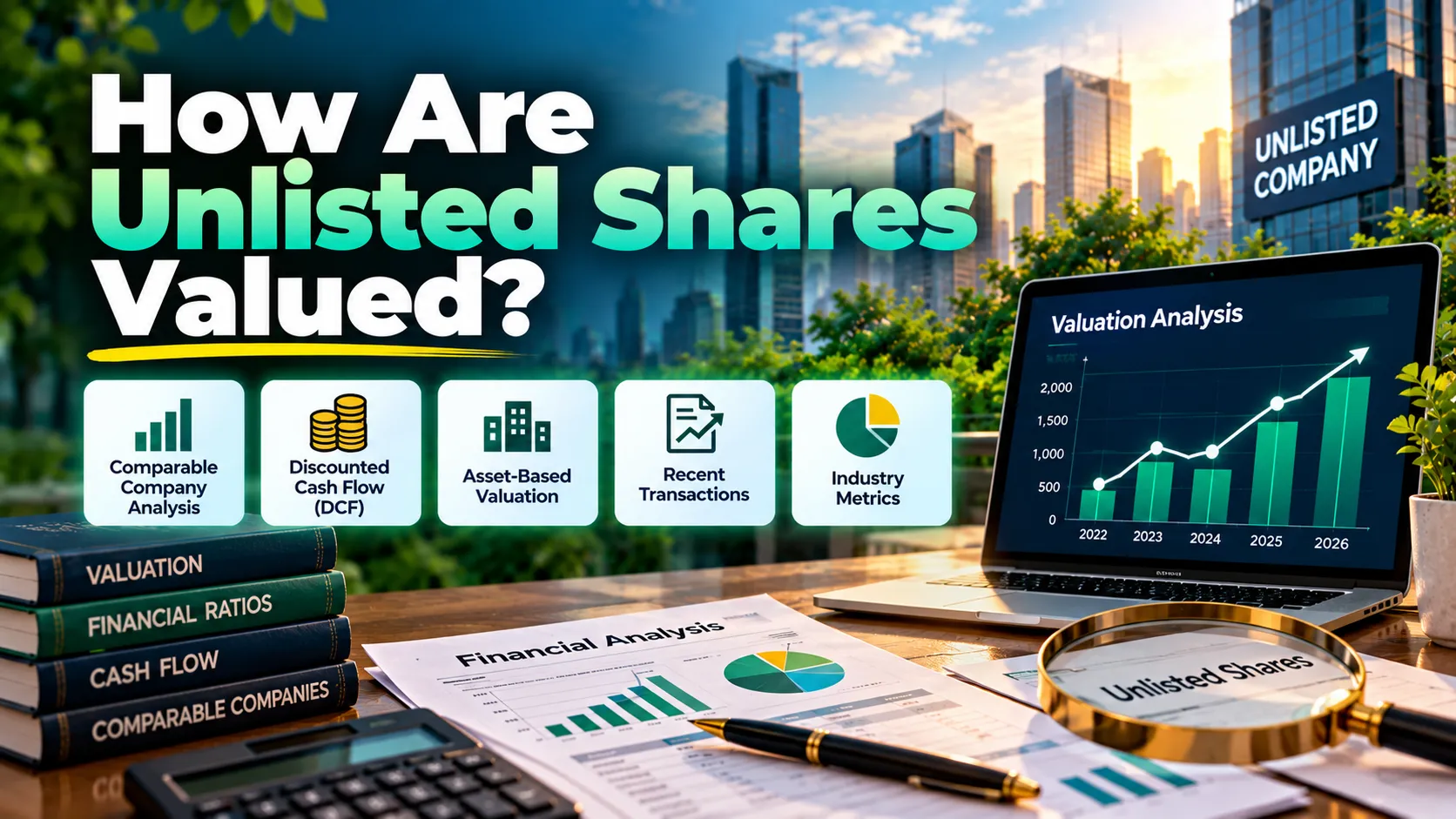
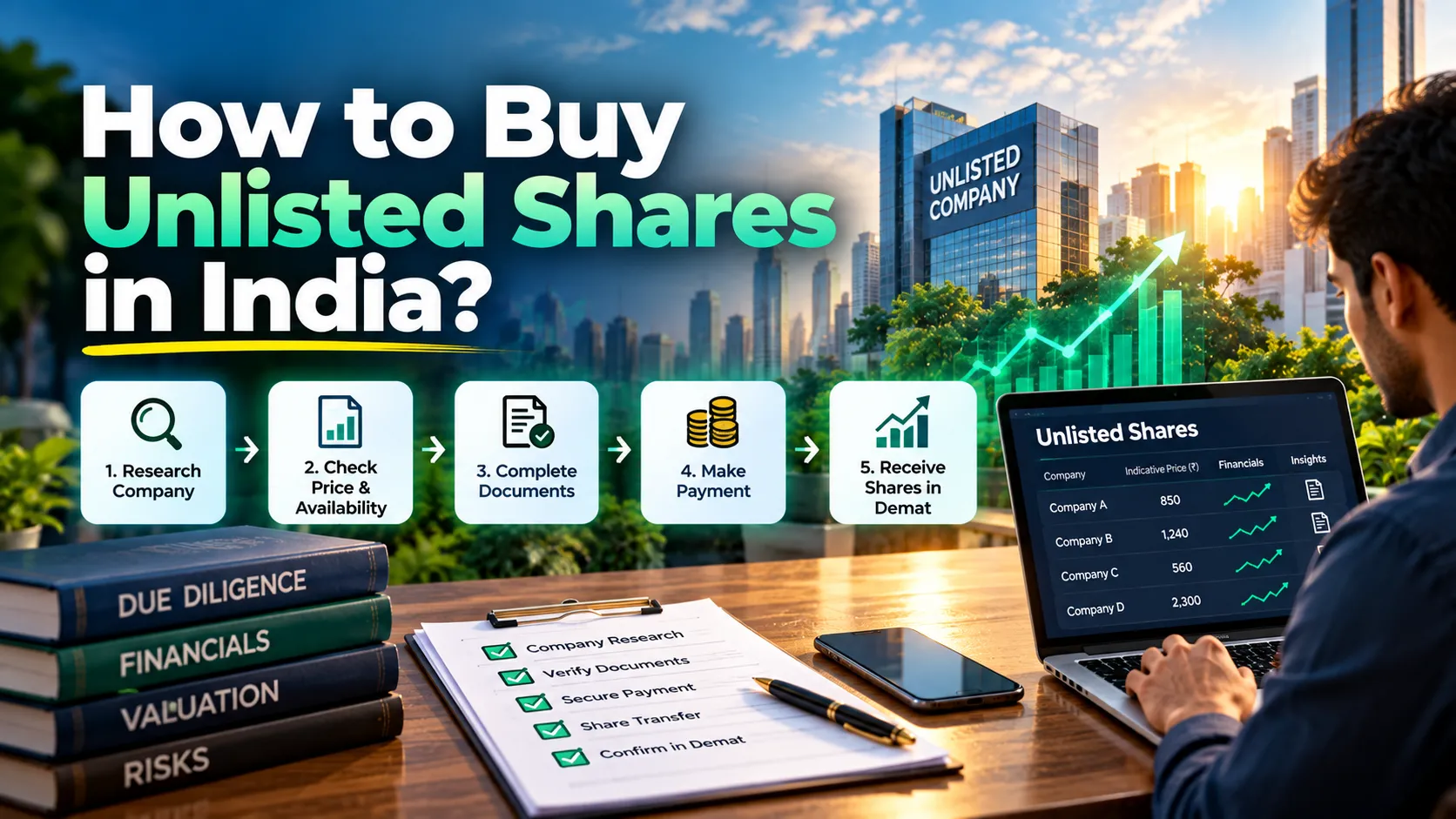
What Are Unlisted Shares?
Unlisted shares are shares of a company that are not listed for trading on a recognised stock exchange. In India, this means the shares are not admitted for exchange-based trading on a recognised stock exchange such as the National Stock Exchange (NSE) or BSE.
The word unlisted describes the listing status of the security, not whether the company is genuine, profitable, large, small, private, or preparing for an IPO.
An unlisted company can issue genuine equity shares, have thousands of shareholders, generate substantial revenue and profits, and even have a well-established business—without its shares being available for normal trading on a stock exchange.
This distinction is important because unlisted shares work differently from listed shares. There may be no continuously quoted exchange price, liquidity can be lower, and transactions can take place through private or off-market arrangements rather than the normal exchange order book.
For investors exploring the unlisted shares market in India, understanding what "unlisted" actually means is the first step.
Unlisted Shares Meaning in Simple Words
In simple terms:
An unlisted share is a share of a company that is not listed for trading on a recognised stock exchange.
When you buy a listed share, your transaction typically takes place through a stock exchange where buyers and sellers place orders and the market determines a quoted price.
An unlisted share does not have that same exchange listing.
The company may still have issued shares, shareholders may still own those shares, and eligible shares may be held electronically in dematerialised form. What is different is that the shares are not available for normal exchange trading.
Under the Companies Act, 2013, a "listed company" is defined as a company that has any of its securities listed on a recognised stock exchange, subject to the statutory provisions and exceptions applicable to specified classes of companies.
SEBI materials similarly describe an unlisted security as a security that is not listed on a stock exchange.
What Does "Unlisted" Actually Mean?
"Unlisted" is often misunderstood.
It does not necessarily mean:
- the company is small;
- the company is new;
- the company is loss-making;
- the company is a startup;
- the company will definitely conduct an IPO;
- the shares have no value; or
- the shares cannot be transferred.
It simply refers to the fact that the security is not listed for trading on a recognised stock exchange.
This is perhaps the most important concept to understand about unlisted shares.
A company can be privately owned and unlisted. It can also be a large, mature business that has chosen to remain unlisted. A company may be considering an IPO while its shares are still unlisted. A security may also become unlisted after a company is delisted, although such situations can involve different regulatory and transaction considerations.
Therefore, "unlisted company" and "startup" are not synonyms, and "unlisted shares" and "pre-IPO shares" are not synonyms either.
How Are Unlisted Shares Different From Listed Shares?
The fundamental difference is the stock exchange listing.
| Feature | Listed Shares | Unlisted Shares |
|---|---|---|
| Listed on recognised stock exchange | Yes | No |
| Normal exchange trading | Available | Not available |
| Continuously quoted exchange price | Generally available during market hours | No equivalent continuous exchange quote |
| Order book | Available on the exchange | No normal exchange order book |
| Liquidity | Generally higher | Generally lower |
| Price discovery | Through exchange trading | Through private/off-market market activity and transactions |
| Buying and selling | Through exchange-based market infrastructure | Through permitted private/off-market mechanisms |
| Public market visibility | Generally high | Generally lower |
| Exit | Usually easier, subject to market conditions | May take longer and depend on buyer availability |
The difference is therefore not that one is a "real" share and the other is not.
Both can represent ownership in a company.
The major distinction is the market in which the security can be traded.
Are Unlisted Shares Real Shares?
Yes, an unlisted equity share can represent genuine ownership in a company.
The fact that a share is unlisted does not by itself make it a derivative, informal certificate or imaginary asset.
An equity shareholder's rights depend on the class of security, the company's constitutional documents and applicable law, but can include economic and corporate rights associated with that class of shares.
Eligible securities can also be held in dematerialised form, depending on the company and security and the applicable requirements.
This means an investor can own shares of a company even when those shares are not available to buy or sell through an NSE or BSE trading screen.
That distinction is fundamental:
Unlisted means "not exchange-listed"; it does not mean "not owned."
Why Do Companies Have Unlisted Shares?
Companies can remain unlisted for many different reasons.
1. The Company Is Privately Held
A private company does not have to become a publicly traded company simply because it grows.
It can raise capital from founders, existing shareholders, strategic investors, private investors, institutional investors or other permitted sources while remaining unlisted.
2. The Company Has Not Yet Gone Public
Some companies may eventually consider an IPO but remain unlisted until the listing process is completed.
This is the broad context in which the term pre-IPO shares is often used.
However, an expectation of a future IPO should never be confused with a completed IPO.
3. The Company Chooses to Remain Unlisted
A company may have no immediate requirement to access public equity markets.
It may prefer private capital, strategic ownership or other financing routes.
4. Shares Exist Outside the Public Market
Employees, early investors, promoters, institutions and other shareholders may hold shares in companies that are not exchange-listed.
These shares can sometimes become available for secondary transactions, subject to applicable rules and restrictions.
5. A Previously Listed Company Becomes Unlisted
A company's securities can cease to be listed under circumstances governed by the applicable regulatory and corporate framework.
This is why delisted shares should be understood separately from ordinary pre-IPO opportunities.
What Are the Different Types of Unlisted Shares?
"Unlisted shares" is a broad category rather than a single type of investment.
Some common situations include:
Private Company Shares
These are shares of companies that are not listed on a recognised stock exchange.
The company may be an early-stage business, a rapidly growing company or a mature private enterprise.
Pre-IPO Shares
These are unlisted shares associated with a company that is preparing for, considering or expected to pursue a public offering.
The key point is:
A pre-IPO share is unlisted, but an unlisted share is not necessarily pre-IPO.
A company can remain unlisted without ever completing an IPO.
Employee or ESOP Shares
Employees may receive equity or options under employee compensation arrangements. In certain situations, shares originating from employee holdings can become part of private secondary transactions, subject to applicable terms and restrictions.
Private Placement Shares
Companies can raise capital by issuing securities to identified investors through permitted private issuance mechanisms.
Shares of Unlisted Subsidiaries or Group Companies
A listed parent or corporate group can have subsidiaries or other entities whose own securities are not listed.
These companies can therefore have unlisted equity even when their broader corporate group includes listed businesses.
Delisted Shares
A share that was once listed but is no longer listed is different from a company that has never been listed.
Investors should therefore determine why the security is unlisted, rather than assuming every unlisted share has the same characteristics.
Unlisted Shares vs Pre-IPO Shares
This is one of the most common areas of confusion.
Consider it this way:
Unlisted shares = the broader category
Pre-IPO shares = one situation within that category
Suppose Company A is privately held and has no immediate IPO plans. Its equity shares are unlisted.
Suppose Company B is preparing for a potential public offering. Its shares are also unlisted, and the shares being transacted before the offering may be described as pre-IPO shares.
Both are unlisted.
Only the second has a specific connection to a potential IPO.
Therefore, investors should understand:
Unlisted ≠ Pre-IPO ≠ Guaranteed IPO
An IPO is a separate corporate and regulatory process, and whether, when and at what valuation a company ultimately lists can depend on numerous factors.
Where Are Unlisted Shares Traded?
This question requires an important distinction.
Unlisted shares are not normally traded through the regular exchange order book of a recognised stock exchange.
Instead, transactions can occur through permitted off-market or private arrangements, depending on the security, parties involved and applicable requirements.
There is therefore no universal equivalent of:
"Open my trading app → search the stock → place an NSE/BSE order."
The absence of an exchange order book also means there may not be one continuously visible market price in the same way there is for a listed share.
Prices may be influenced by:
- Recent transactions
- Buyer and seller demand
- Quantity available
- Company fundamentals
- Valuation
- Expected corporate events
- Liquidity
- Other market conditions
The detailed mechanics of this process are different enough to deserve their own guide rather than being buried inside this introductory article.
Why Don't Unlisted Shares Have a Live Market Price?
A listed stock has an exchange-based market where buy and sell orders interact continuously.
That activity produces a visible market price.
An unlisted share does not have the same exchange order book.
Consequently, there may be no single continuously updated exchange price.
This is one of the defining characteristics of the unlisted market.
Two transactions involving the same company could potentially occur at different prices because the circumstances may differ in:
- quantity;
- timing;
- buyer demand;
- seller urgency;
- available supply;
- transaction terms; or
- perceived value.
This is why investors should distinguish between an indicative or quoted private-market price and a continuously discovered exchange price.
Can Unlisted Shares Be Held in a Demat Account?
Yes, eligible unlisted securities can be held in dematerialised form, subject to the applicable requirements.
This is an important point because some people assume that:
"If a share is not listed, it must exist only as a physical share certificate."
That is not necessarily true.
Dematerialisation allows eligible securities to be represented electronically through the depository system.
For investors researching the practical side of ownership, topics such as demat accounts, CDSL, NSDL and off-market transfers become relevant.
Unlisted Arena also maintains investor resources covering practical aspects of holding and dealing with unlisted shares.
Why Are Unlisted Shares Less Liquid?
One of the biggest practical differences between listed and unlisted shares is liquidity.
Liquidity refers broadly to how easily an asset can be bought or sold without requiring a significant change in price.
A listed stock may have a large number of buyers and sellers interacting through an exchange.
For an unlisted share, the pool of potential buyers can be much smaller.
As a result, an investor may not always be able to sell an unlisted share exactly when they want, in the quantity they want, or at the price they expect.
SEBI materials identify unlisted securities as potentially having less liquidity and greater risk than securities traded in the open market.
This does not mean every unlisted share is illiquid to exactly the same degree.
Liquidity can vary substantially between companies and securities.
Are Unlisted Shares Riskier Than Listed Shares?
Unlisted shares can involve higher liquidity and valuation uncertainty than exchange-listed securities.
The primary issue is not simply that the company is unlisted.
The risk profile can be affected by:
Liquidity Risk
There may be fewer buyers when an investor wants to exit.
Valuation Risk
Without a continuously quoted exchange price, determining an appropriate value may require more analysis.
Information Risk
The amount and frequency of information available to investors can vary between companies.
Business Risk
An unlisted company remains exposed to the normal risks of running a business—competition, regulation, economic conditions, debt, management decisions and industry disruption.
Corporate Event Risk
If an investment thesis depends on an expected IPO, merger, fundraising or other event, that event may not happen in the manner or timeframe anticipated.
SEBI has specifically noted that unlisted securities may have greater price fluctuations and less liquidity than securities traded in the open market, and that there may be no assurance of realising an investment at fair value.
Does "Unlisted" Mean "Undervalued"?
No.
This is one of the most dangerous misconceptions surrounding unlisted shares.
An unlisted company is not automatically cheap simply because it is not listed.
The value of any share depends on the underlying business, financial performance, future prospects, capital structure, comparable valuations, market conditions and other relevant factors.
An unlisted company can be:
- undervalued,
- fairly valued, or
- overvalued.
The lack of a stock exchange listing tells you how the shares trade, not whether they are attractively priced.
This is why a proper analysis of the business and valuation is essential before considering an unlisted investment.
Does Every Unlisted Company Eventually Get an IPO?
No.
A company may remain unlisted for years or indefinitely.
Some companies may eventually file for an IPO, while others may raise private capital, pursue strategic transactions or continue as unlisted businesses.
Even when a company is associated with a potential IPO, investors should distinguish between:
IPO speculation
and
a formal IPO process.
For companies that have filed a Draft Red Herring Prospectus (DRHP), investors can track the relevant information through the applicable regulatory disclosures.
Unlisted Arena also maintains a DRHP Watchlist for companies that have filed DRHPs.
Why Do Investors Look at Unlisted Shares?
Investors may explore unlisted shares because they can provide exposure to companies before or outside the listed-stock market.
Interest can arise from several factors:
Early-stage or growth exposure
Some investors seek exposure to businesses before they enter public markets.
Access to private companies
Some established businesses remain outside the listed market.
Potential corporate developments
An expected IPO or another corporate event can influence investor interest.
Portfolio diversification
Unlisted securities provide exposure to companies that may not yet be available through conventional exchange trading.
But these potential attractions should always be considered alongside liquidity, valuation, business and transaction risks.
A Simple Example of an Unlisted Share
Imagine a company named ABC Technologies Limited.
The company has:
- 1 crore equity shares;
- established operations;
- several hundred shareholders;
- annual revenue and profits; and
- shares held by investors in dematerialised form.
However, its shares are not listed on NSE or BSE.
Those shares are therefore unlisted shares.
Suppose two eligible parties agree to transfer 10,000 shares at ₹500 per share.
The transaction may create evidence of a private-market transaction at ₹500, but that does not mean there is a continuously quoted ₹500 exchange price like there would be for a listed stock.
Another transaction could potentially occur at a different price depending on the circumstances.
The example illustrates the central difference:
The company and its shares can exist and have value even though there is no stock-exchange trading price.
Unlisted Shares: Common Misconceptions
"Unlisted shares are not regulated at all."
That is too broad.
Different parts of the unlisted ecosystem can fall under different laws, regulations and regulatory frameworks depending on the company, security and transaction.
The absence of an exchange listing does not mean that every rule disappears.
"All unlisted shares are Pre-IPO."
Incorrect.
Pre-IPO shares are one category of unlisted shares. Many unlisted companies have no immediate IPO.
"Unlisted means cheap."
Incorrect.
Listing status does not determine valuation.
"If a company is going to IPO, its unlisted shares must rise."
Not necessarily.
An IPO can involve changes in valuation, market conditions, investor sentiment and supply-demand dynamics. There is no guaranteed listing gain.
"Unlisted shares cannot be held in demat."
Incorrect.
Eligible unlisted securities can be dematerialised and held electronically, subject to applicable requirements.
"Every unlisted company is a startup."
Incorrect.
Unlisted companies can range from young businesses to mature and established enterprises.
What Should You Understand Before Investing in Unlisted Shares?
Before considering an unlisted company, investors should look beyond the fact that its shares are unlisted.
Important questions include:
What does the company do?
Understand the business model, industry and competitive position.
How is the company performing financially?
Review revenue, profitability, margins, cash flows, debt and other relevant financial indicators.
Who owns the company?
Study the shareholding structure and important shareholders.
What price are the shares available at?
Understand the basis for the quoted or negotiated price and assess the valuation.
How liquid are the shares?
Consider how readily a buyer may be available when you want to exit.
Is there a genuine corporate-event thesis?
If the investment case depends on an IPO or another event, understand what is actually known versus what is only expected.
What are the terms and restrictions?
Check the nature of the security, transfer conditions and relevant documentation.
The company's fundamentals remain important regardless of whether its shares are listed.
Unlisted Shares in India: The Bigger Picture
The Indian equity market is not limited to companies whose shares appear on a stock-exchange screen.
A much larger ecosystem exists around private companies, unlisted subsidiaries, employee shareholders, institutional investors, private capital and companies that may eventually enter the public markets.
For investors, this creates a different research environment.
A listed company offers a visible market price, exchange liquidity and extensive public-market information.
An unlisted company may require the investor to go deeper into:
- financial statements;
- valuation;
- ownership;
- corporate actions;
- transaction history;
- liquidity;
- potential corporate developments; and
- the terms under which the shares can be transferred.
That is precisely why research becomes particularly important in the unlisted market.
Unlisted Shares Explained in One Minute
If you remember only five things from this article, remember these:
1. Unlisted shares are shares that are not listed for trading on a recognised stock exchange.
2. Unlisted does not mean the shares are not real or do not represent ownership.
3. Pre-IPO shares are a type or situation within the broader unlisted-share universe, but not every unlisted share is pre-IPO.
4. Unlisted shares generally do not have the same continuously quoted exchange price and liquidity as listed shares.
5. Unlisted does not automatically mean undervalued, and an expected IPO does not guarantee investment returns.
Frequently Asked Questions About Unlisted Shares
What are unlisted shares?
Unlisted shares are shares of a company that are not listed for trading on a recognised stock exchange.
What is the meaning of unlisted shares in India?
In India, unlisted shares generally refer to securities that are not listed on a recognised stock exchange. They can belong to private or otherwise unlisted companies and can be subject to different transaction, transfer and regulatory requirements.
Are unlisted shares real shares?
Yes. An unlisted equity share can represent ownership in a company. The rights attached to the shares depend on the class of security, company documents and applicable law.
Can unlisted shares be held in a demat account?
Eligible unlisted securities can be held in dematerialised form subject to applicable requirements.
Are unlisted shares and pre-IPO shares the same?
No. Pre-IPO shares are a subset of the broader universe of unlisted shares. An unlisted company does not necessarily have an upcoming IPO.
Can unlisted shares be bought and sold?
Eligible unlisted shares can potentially be transferred through permitted mechanisms, including off-market or private transactions, depending on the security and applicable requirements.
Do unlisted shares have a market price?
They can have quoted or negotiated transaction prices, but they generally do not have a continuously updated exchange price in the same way as a listed stock.
Why are unlisted shares less liquid?
They do not have the same exchange-based order book and broad pool of continuously interacting buyers and sellers. Finding a counterparty can therefore take longer.
Are unlisted shares riskier than listed shares?
They can involve greater liquidity, valuation and information risks, although the risk profile varies significantly between companies and securities.
Are all unlisted companies going to IPO?
No. Many companies can remain unlisted without completing an IPO.
Does unlisted mean undervalued?
No. An unlisted share can be undervalued, fairly valued or overvalued. Listing status alone does not determine intrinsic value.
What is the difference between unlisted and delisted shares?
An unlisted company or security may never have been listed, whereas a delisted security was previously listed and subsequently ceased to be listed. The circumstances and applicable rules can differ.
What is an unlisted company?
An unlisted company is generally understood as a company whose securities are not listed on a recognised stock exchange. The Companies Act, 2013 defines a "listed company" with reference to securities being listed on a recognised stock exchange.
Final Word
Unlisted shares are simply shares that are outside the normal stock-exchange trading system.
That one distinction creates an entirely different investment environment.
There is no reason to assume that an unlisted company is automatically small, risky, cheap, early-stage or destined for an IPO. The important question is not merely whether a company is listed.
The more useful questions are:
What does the company do?
How strong are its financials?
What is the business worth?
What price are the shares available at?
How liquid are the shares?
What are the possible routes to an exit?
For investors researching opportunities in the Indian unlisted market, these questions matter far more than the label "unlisted" itself.
At Unlisted Arena, our Knowledge Centre is designed to help investors understand the concepts behind the unlisted and pre-IPO market, while our individual company pages bring together company-specific information such as share prices, charts, financial statements, financial ratios, valuation metrics, shareholding patterns, annual reports, corporate actions, key insights, FAQs and related research.
Explore the Unlisted Shares section to research individual companies and available opportunities, or learn about the process of buying unlisted shares.